How to protect your legacy, strengthen your future, and prepare for what’s next
PUBLISHED: August 2026
By Jason Gazaille, Vice President of Finance for Funeral Directors Life
and Ian Seekins, Director of Funeral Home Lending for Funeral Directors Life
Quick summary
Succession planning prepares funeral home owners for a future transition by protecting the business, supporting staff, organizing finances, and preparing new leadership before urgency limits their options. Here’s what to remember:
- Start early: Begin succession planning 5–10 years before stepping away to prepare financials, mentor successors, reduce owner dependence, and protect business value.
- Define priorities: Rank what matters most, including retirement security, family legacy, staff continuity, local identity, sale price, speed, and excellent care.
- Understand value: Funeral home value depends on EBITDA, revenue, real estate, goodwill, call volume, preneed strength, clean financials, and transferability.
- Evaluate successors: Review family members, key employees, outside buyers, or local operators for readiness, values, financing ability, and long-term fit.
- Protect legacy: Clear communication and a Legacy Playbook help preserve staff confidence, community trust, service standards, relationships, and culture.

Move succession planning out of the “someday” pile
Succession planning is one of those topics that can sit in the background for years.
Not because it’s unimportant, but because most funeral home owners, like you, think they have plenty of time to plan for the future. Plus, when succession planning carries such emotional and financial weight, it can feel safer putting it off for “someday.”
And who could blame you? You’re focused on what is right in front of you. You’re serving families, leading your staff, managing expenses, and solving problems. All while trying to keep your business healthy in a profession that keeps changing.
But while focusing on today's families is your calling, ignoring tomorrow's transition is a risk to the very families you serve. Because every funeral home owner faces a hidden villain: urgency. If you don't choose your funeral home's successor, they will choose one for you.
That’s why succession planning deserves more than a place on your “someday” pile.
Many funeral home owners believe succession planning is about selling their business and retiring. But it’s more than that. It is about making sure your funeral home’s care and culture continue to thrive — and that your staff is supported — under the next generation of leadership. Succession planning touches legacy, family, timing, fairness, financial security, and identity.
As a funeral home owner, succession planning is one of the most meaningful decisions you will make because it means protecting the culture you’ve built and the families who depend on you. And when you wait too long, you lose time, options, the chance to mentor the right person, the leverage to command the best price, and the peace of mind that your legacy is secure.
When it comes to succession planning, you may be asking yourself:
- What if I’m not sure I’m ready to let go?
- What if my children don’t want the business?
- What if I’ve waited too long to plan my succession?
- What if no one can preserve what we’ve built?
- What if something unexpected happens before I’m ready?
- What if my best options are all imperfect?
- Who should be interested in purchasing my funeral home?
Those questions are real, and the weight behind them can make the next step feel hard to choose. But you don’t have to map out the entire transition today. You just have to stop letting time and urgency win.
This guide is designed to help you move succession planning from the “someday” pile to a position of strength, so that the funeral home you built continues to thrive long after you’ve stepped away.
But before you go any further, it helps to take an honest look at where things stand for you and your funeral home today.

Quick self-check
To determine how ready you and your funeral home are for a transition, here are 5 questions to think about:
- Do you know what your funeral home is worth right now?
- Do you know who could realistically lead your funeral home next?
- Are your financials clean enough for a lender, buyer, or advisor to review?
- Have you communicated your long-term vision to anyone?
- If something unexpected happened to you, would your family or staff know what to do?
If those questions feel uncomfortable, that’s OK. You don’t have to solve everything today. All you need is a place to begin.
Already received an offer for your funeral home?
If you've been approached by a buyer or consolidator and are evaluating the deal, this guide can help. Start with Section 2 to clarify what matters most to you, then use Section 3 to understand whether the offer reflects your funeral home's true value.
Feel behind? Start here.
If you do nothing else this month, take these 3 simple steps to move succession planning out of the "someday" pile:


Whether you are 5 years from retirement, planning farther ahead, considering a family transition, preparing an employee for ownership, or simply trying to understand what your funeral home is worth, this guide is designed to help you move forward with clarity and peace of mind.
And if you're a funeral professional who's been thinking about ownership, this guide can help you understand what your current employer may be thinking about and how transitions actually work.
Let’s start by defining what succession planning actually looks like and why it matters much sooner than you think.

1. When should you start succession planning for your funeral home?
The term “succession planning” is used in many different ways. For some funeral home owners, it means retirement. For others, it’s estate planning or finding a buyer. Sometimes it just means, “I know I need to do something, but I’m not sure where to start.”
Let’s start with a simple definition.
Succession planning is the process of preparing your business, people, finances, and leadership for a successful future transition.
That includes:
- Ownership transition and leadership readiness
- Financial structuring and business valuation
- Emergency continuity and communication planning
- The protection of your service standards and culture
In other words, succession planning is a way to make sure your funeral home can continue operating at the high standards you’ve established when your role changes.
How is succession planning different from estate or retirement planning?
These conversations overlap, but they are not the same.


Succession planning is not a will, a retirement account, or a last-minute buyer search.
Succession planning is the intentional work of preparing your funeral home for what comes next.
What is the ideal timeline for a funeral home transition?
If there is one lesson worth taking seriously, it's this: the earlier you begin succession planning, the more options you'll have.
In our experience, the most successful funeral home transitions are those that begin at least 5-10 years before the owner intends to step away. This gives you the time you need to get your books in order, mentor the right person, and make sure you get the full value for the business you’ve built.
Starting early gives you the advantage and helps you:
- Raise your asking price: You have time to make operational improvements that will have a lasting impact on the value of your business.
- Mentor successors: You can gradually transition relationships with families and the community.
- Prove the business can run without you: Show your funeral home thrives when you aren't there (which makes it more valuable to a buyer or lender)
- Lead with purpose: You get to make decisions based on your goals, not under the pressure of a deadline.
Starting early is what many leaders in the funeral profession see as the make-or-break factor for a successful transition.
The biggest thing is to start earlier than you think. You have to really understand what your business is and start mentoring somebody within your own funeral home. If you have staff that might be interested in taking over, you have to recognize that value and believe it’ll pay out.
— Miki Tufto, Executive Director, Minnesota Funeral Directors Association
When owners wait too long, pressure builds quickly. This often leads to a lower selling price, fewer choices for a successor, and a transition driven by time and urgency instead of your original purpose.
How do you protect your funeral home from the unexpected?
There are two planning conversations every owner must have:
- Long-term succession planning: The roadmap for a planned transition over the years.
- Emergency continuity planning: The “break glass in case of emergency” plan for sudden illness or injury.
Even if retirement is a decade away, ask yourself: If I became unavailable tomorrow, would my family know where the important documents are? Would my staff know who has decision-making authority?
We've seen firsthand how a simple “Emergency Folder” can prevent chaos for a funeral home.
At a minimum, it should include:
- Who has decision-making authority for the business
- Where your legal documents, insurance policies, and financial records are stored
- Contact information for your attorney, CPA, lender, and insurance provider
- Login credentials or access instructions for critical business systems
- Instructions for your staff on how to operate day-to-day if you're unavailable
And make sure it's stored digitally in a place your family and key staff can access. A folder no one can find when they need it most isn't a plan.
Having an emergency backup plan protects your loved ones from having to make impossible business decisions during their own time of grief.
What are the most common succession planning mistakes to avoid?
We’ve seen a few problems show up consistently for funeral home owners that derail succession plans and personal legacies:
-
The “Time Trap”: Assuming there will always be more time to plan later.
-
Emotional avoidance: Putting off the succession planning conversation because it feels too personal or uncomfortable.
-
The “Ready vs. Willing” gap: Confusing a family member’s willingness to help with their readiness to lead.
-
Urgency-driven exits: Waiting until health issues or burnout force a rushed sale.
These mistakes share a common thread: They all happen when planning takes a back seat to the day-to-day demands of running your funeral home. The good news is that recognizing them now puts you in a position to avoid them.
Good succession planning begins with vision. Before you think about numbers, think about the future you want for your funeral home, your staff, and the community you serve.

What is a realistic timeline for your succession?
It helps to think in broad windows, not rigid deadlines:
- 10+ years out: Clarify your long-term vision, identify possible successor paths, and start reducing “owner dependence.”
- 5–10 years out: Clean up financials, improve business value, and begin conversations with trusted advisors.
- 3–5 years out: Explore formal valuations, assess financing possibilities, and evaluate successor readiness.
- 1–3 years out: Define the deal structure, complete legal and tax planning, and begin transitioning leadership responsibilities.
Regardless of where you fall on this timeline, the goal is the same. You must move from a transition driven by time and urgency to one driven by purpose. When you start with a clear vision, the numbers and logistics naturally begin to fall into place.
But first, you need to define what that vision actually looks like for you.

2. How do you define a successful funeral home transition?
Before you get too deep into successor options, valuations, or financing, we always encourage owners to answer one simple question: What are you truly trying to protect?
Not every funeral home owner wants the same outcome, and your priorities will shape your succession planning decisions. Some owners care most about getting the highest sale price to secure their retirement, while others are more concerned with keeping the funeral home locally owned or ensuring their staff is taken care of.
There are no wrong answers here. But there are always trade-offs.
Rank your priorities before you choose a path
If you haven’t written them down lately, take a moment to rank these priorities from most to least important to you. Be honest with yourself, as this clarity can help prevent seller's remorse later on.
- Retirement security: Making sure you have enough funds for your next chapter.
- Family legacy: Passing the business to the next generation.
- Keeping your staff together: Protecting the people who have helped you build the business.
- Local identity: Keeping the funeral home independent and community-focused.
- Highest sale price: Maximizing the financial return on your life’s work.
- Speed of transition: Moving through the process as quickly as possible.
- Continuity of care: Ensuring families see no dip in service standards.
The hidden reality of trade-offs
During your succession planning, you may have to choose between getting the highest possible price for your funeral home or choosing the person you most want to lead your staff. Knowing which one really matters to you prevents a crisis of conscience later.
For example, if protecting your funeral home’s reputation and staff continuity are at the top of your list, an outside corporate buyer offering the highest price might not be the right fit. On the other hand, if financial security for your retirement is your main goal, understanding your funeral home's true value becomes even more important.
But no matter which priority sits at the top of your list, knowing what your business is worth gives you the clarity to make the best decision for your future, your staff, and the families you serve.

Who can help you plan your funeral home’s succession?
We’ve seen many owners try to “DIY” their succession plan to save on fees, only to end up with a deal that costs them much more in taxes or legal headaches later.
But you don’t have to figure this out alone. The right team helps you ask the questions you didn’t know you needed to ask.
Depending on your goals, your “Succession Support Team” should include:
- CPA or Accountant to organize your books and show the real profit your funeral home makes once personal expenses are taken out.
- Valuation Professional to give you a realistic, unbiased number for what your business is worth in today’s market.
- Lender to help you understand your financing options, especially if you are looking at a partner buyout or a key-employee transition.
- Attorney to handle the paperwork, protect your interests, and make sure the hand-off is legal and binding.
- Financial Planner to coordinate your business sale with your personal retirement goals.
- Trusted Business Advisor to act as your quarterback and keep the process moving so your vision stays front and center.
When you meet with your support team, don't just ask “What should I do?” Ask them, “Based on my main goals for this transition, what is the biggest obstacle you see in my current financials or legal structure?” This forces your advisors to give you actionable feedback rather than general advice.
The cost of silence
The most expensive mistake in succession planning is silence. Even if you aren't ready to sell or retirement is decades down the road, starting the conversation today with just one trusted advisor is how you defeat the “Villain of Urgency,” which is what happens when you wait so long that the timeline starts making your decisions for you.
By starting the conversation now, you avoid the high cost of having no options later. When you're forced to move quickly, you rarely get the best price or the best terms for your funeral home and legacy.

Who should you talk to first about succession planning?
You don't need to call every advisor on your Succession Support Team today. Start with the one person who can answer the question that's weighing on you most, whether that's your CPA, an attorney, or a lending partner who understands funeral homes.
When you do sit down for that first meeting, don't be afraid to ask the tough questions:
"Are my books actually ready for a review?" or "Based on my goals, is my timeline realistic?"
Succession planning gets much easier when you stop carrying the weight of the unknown and start building a team that can help you protect your legacy.

3. What is your funeral home actually worth?
A lot of owners have a general sense of what their funeral home means to their community. But that is very different from having a clear, documented understanding of what the business is actually worth to a lender or a buyer.
That distinction matters. Because if you don’t know your funeral home’s true value, you are essentially fighting the Villain of Urgency with one hand tied behind your back.

Knowing what your funeral home is truly worth
Your funeral home’s value comes down to what your business can clearly prove through earnings, assets, operations, and market position. When we look at a transition, several factors shape that final number. But only one serves as the “heartbeat” of your business: EBITDA.
EBITDA stands for Earnings Before Interest, Taxes, Depreciation, and Amortization. In plain English, EBITDA shows how much cash your funeral home actually makes from serving families. It’s also the first thing a lender looks at to see if your business is healthy.
But EBITDA alone doesn't determine your asking price. What matters next is how that number is used to calculate your funeral home's overall value.
The role of multiples
Your funeral home's final price isn't based on a single year's profit. A buyer or lender will look at your EBITDA and then multiply it by a number that reflects the strength of your business. The stronger and more organized your funeral home looks on paper, the higher that multiple will be.
In other words, cleaning up your books and building a team that can operate without you makes your funeral home easier to sell and can directly increase your asking price.
The specific multiple that applies to your funeral home depends on factors that go well beyond a simple formula, and getting it wrong in either direction can cost you.
There are several other factors that shape the true value of your funeral home:
- Revenue: Steady or growing revenue signals that families continue to choose your funeral home. A buyer or lender wants to see that your income is consistent, not dependent on a handful of unusually large years.
- Real estate: This includes the physical land and buildings you’ve maintained and improved over the years.
- Goodwill: This is the value of the trust, reputation, and relationships you’ve built. In the funeral profession, goodwill is often your most valuable asset because trust is your primary currency.
- Call volume trends: Consistency is everything. A stable or growing call volume builds confidence for a buyer or lender, while a declining trend without a clear explanation creates risk and can lower your overall value.
- Consistency in how you serve families: A funeral home with documented, repeatable processes signals stability and professionalism to prospective buyers or lenders. If your systems and workflows only exist in your head, that's a risk factor that can work against you.
- Preneed book strength: The size, funding quality, and maturity of your preneed program directly affect your funeral home's value and attractiveness to a buyer or lender.
Even if your funeral home is smaller, your goodwill, relationships, and preneed book have real value. Don't assume a transition isn't possible just because you're not doing 1,000 calls a year.
A funeral-home-specific lender can walk you through exactly how these numbers apply to your situation.
Why clean financials matter more than you realize
Lenders, buyers, and advisors all need confidence in your funeral home’s numbers. If your books are filled with personal expenses or inconsistent entries, it makes it harder to prove your business's true value.
To get a clear picture, you need financial clarity. You can start with:


If you have messy books, that doesn’t automatically mean you have a weak or low-value funeral home. But it does make it harder to defend your asking price.
Here’s what one funeral home owner had to say about the relief he felt once he discovered the true value of his business.
Most funeral home owners have a figure in their head of what they think their business is worth, but there’s often nothing to back it up. I never wanted to just guess at that number. Now, I know what my business is worth. Getting a valuation has given me a clear understanding of where I stand, so I can continue to build and maintain that value.
— Marlan Gary, CEO & Founder, Marlan Gary Funeral Homes
Understanding your funeral home's true value changes the way you think about timing, readiness, and what kind of transition is actually possible.
But there's another side to value that many owners overlook. It's not just about what the business earns. It's about whether the business can keep earning without you.
The "Transferability" Test: How to reduce owner dependence
Clean financials show what your funeral home earns. But a buyer or lender is also evaluating something else: Can this business keep earning without the current owner?
A funeral home that depends entirely on one person is harder to value and finance. If every major decision and relationship for your funeral home starts and stops with you, you’ve unfortunately built a job that no one else can do.
And to a successor, that looks like risk.
Transition-readiness is all about transferability, not just income. You can start increasing your funeral home’s value today by documenting your daily systems and workflows, delegating important community relationships to your staff, and training your team to make decisions while you are still there to mentor them.
What increases your funeral home’s value?
To strengthen your position, focus on the factors that appraisers and lenders look for most:
-
Strong and consistent cash flow
-
Clean and professional financials
-
Stable or growing case volume
-
Trained leaders who reduce dependence on you
What decreases your funeral home’s value?
On the flip side, know which scenarios to avoid:
- Messy or disorganized books
- Heavy owner dependence
- Declining call volume without a clear explanation
- An unclear path for the transition itself
Practical pre-valuation checklist
Before you talk to an appraiser, lender, or buyer, make sure you can answer “yes” to these essentials:
- Are my profit and loss statements current? You should have accurate statements from at least the last 30 to 60 days.
- Have I identified personal expenses? Make a list of any personal items that should be removed to show the true operating profit of your funeral home.
- Is my real estate documentation ready? Gather your deeds and most recent property appraisals.
- Do I have a 3-year call volume report? And make sure this is categorized by service type so trends are easy to spot.
- Is my ownership structure clear? Have all your legal documents organized and in order.
If you can't answer "yes" to all of these yet, that's OK. You now know where to start, and a good advisor can help you get there faster.
A clear picture of your financials is the foundation for every good succession plan. Qualified accountants, valuation experts, and funeral-specific lending partners can help you understand and feel confident about your position.
The cleaner your numbers are and the less dependent your funeral home is on you, the stronger your options will be when it's time to step away.
Once you have a clear picture of what your funeral home is worth, you can begin to answer the most personal question in this entire process: Who is the right person to lead your legacy into the next generation?

4. Who should take over your funeral home?
In the last section, we talked about how reducing owner dependence is where the succession planning conversation gets practical. But once you've built a funeral home that can run without you, the conversation gets personal.
Because it's one thing to say, "I know I need a succession plan." But it's another to look around and ask,
"Who is actually going to lead this place?" and "What is that going to look like for my staff and families?"
There isn't a guaranteed right answer that works for everyone. The best fit for your funeral home depends on readiness, values, and the kind of future you want for the business you've spent your life building.
What are the most common funeral home successor paths?
Most funeral home transitions follow one of three paths: passing the business to a family member, transitioning ownership to a trusted employee, or selling to an outside buyer. Each path comes with its own strengths and challenges.
Family members
A family transition is a great way to preserve your funeral home’s legacy. You may have a son, daughter, or relative who has a strong emotional connection to the business and a genuine desire to protect what you've built.
But just because a family member is interested doesn’t mean they are ready to take over your funeral home just yet. Training, role clarity, and leadership development still matter.
An important situation to consider:
When several children are involved but only one is active in the business, deciding how to divide ownership can become one of the hardest conversations in the entire succession planning process. Sometimes fair doesn't mean equal, and splitting ownership evenly between a child who runs the funeral home and one who can’t will create confusion, conflict, and gridlock.
In these scenarios, many owners transfer the funeral home's ownership to the successor who is doing the work, while using other financial assets, such as life insurance, to provide for children who are not part of the business.
Key employees
A trusted employee already knows your families, understands your culture, and has the respect of your staff. In many cases, they are the most natural choice to keep your funeral home running smoothly because they already lead with the care and empathy that families expect.
At the same time, moving from “star employee” to “funeral home owner” is a big transition. A great funeral director has already mastered caring for families, which is the most important part of the job. The next step is simply giving them the time and mentorship they need to learn the business side of the profession, like financial management and long-term strategic planning.
With the right coaching, a great funeral director can become a great funeral home owner who protects your legacy for years to come.
Keep in mind that your successor may also need specific state licenses before they can legally operate the funeral home. If they're not yet licensed, that timeline affects your entire succession plan, so factor it in early.
Outside buyers or local operators
An outside buyer may offer speed, more available cash, or a simple exit. This path is often the best fit when no internal successor exists.
But choosing a third-party buyer also raises questions:
-
Will your reputation and local identity stay the same?
-
Will your funeral home’s service standards change?
-
Will the community still trust the name on the sign?
-
Does the buyer's track record with other acquisitions reflect the values you care about?
An outside transition can be a good option, but your evaluation of the buyer should go well beyond the price they offer. Look at their operational track record, their approach to staff retention, and how they've handled other acquisitions in the profession.
What if there is no obvious successor for your funeral home?
This situation is more common than many owners realize. If your children aren't interested in taking over the business and your staff isn't ready, you still have options. You might choose to develop a junior employee over several years, consider a phased partnership, or look for an outside operator who shares your specific values.
Succession planning often involves making wise trade-offs. Even if it’s not the perfect option, choosing the best available option can still be wise if it protects the things you care about most.
If you're unsure how to evaluate your successor's readiness, a trusted advisor who's seen dozens of funeral home transitions can help you ask the right questions.
How do you know if a successor is truly ready?
To move past the “willingness” and look at the “readiness” of your possible successor, ask yourself these questions:
-
Does this person want the responsibility of my funeral home or just the owner title?
-
Have they shown they can make tough decisions under stress and pressure?
-
Do they understand how we actually make and lose money?
-
Can they earn the trust of the staff and community?
If your possible successor takes initiative, earns families' trust, and wants ownership for the right reasons, then they are probably closer to the “readiness” side of the scale.
However, if they avoid hard decisions, struggle to lead the team consistently, or lack a basic understanding of your funeral home's financials, then they likely need more time to develop and learn.
These questions are a starting point. But objectively evaluating someone you work with every day is harder than it sounds. An outside perspective can reveal blind spots that are difficult to see from the inside.

What is your role after the transition?
Once you have a clear sense of your successor's readiness, there's a related question worth answering early: What does your role look like after the transition?
Some owners stay on for 6-12 months in a consulting or advisory capacity to help the new leader build confidence. Others step into a part-time role, maintaining family relationships while gradually stepping back. And some prefer a clean break once the papers are signed.
Again, there's no single right answer, but the arrangement needs to be clearly defined. Moving into a helpful role in your funeral home supports the new leader without undermining them, while an undefined role can create confusion for your staff, your successor, and the families you serve.
Your CPA and attorney should review your post-transition role early to make sure it is clear, fair, and tax-efficient. If your deal includes a non-compete agreement, make sure your attorney reviews the scope, geographic boundaries, and duration before you sign. And don't overlook the importance of a non-disclosure agreement during the evaluation and sale process. You want to protect your financials and business details whenever you share them with potential buyers.
What are the best ways to finance a funeral home transition?
With the right successor identified and your future role defined, the next question becomes practical: How do you actually fund the transition?
The deal's structure is just as important as the person taking over. While a succession plan includes a sale price, it's also about creating a deal that is realistic and sustainable for both parties.
This is where many owners and potential buyers hit roadblocks with traditional lenders and banks, who don't understand the unique business model and value of funeral homes.
I tried to work with some local banks in our area, but it was extremely frustrating and very disappointing. I had bankers telling me I was at a dead-end with my dream of owning a funeral home. It was all very disheartening.
— Chris Ray, Owner & Funeral Director, Oliver Funeral Home of Eupora
Unfortunately, Chris's experience is all too common for many funeral professionals. But a "no" from a traditional lender or bank doesn't mean the transition is impossible. It usually means the bank doesn't understand how funeral homes work.
To find a path forward, you first need to understand the different levers you can pull to fund a deal. Most transitions are funded with conventional bank loans, SBA-backed financing, seller financing, earnouts, blended structures, or a mix of these options. The right combination depends on your specific situation, your successor's financial position, and the deal structure you're targeting.
But regardless of which levers you pull, partnering with a funeral home-specific lender changes the conversation entirely. Instead of spending your time educating a bank on how your business works, you're working with a team that already understands your revenue model, your preneed book, and the unique factors that drive funeral home value.
That means fewer roadblocks, more realistic deal structures, and a partner who can see your succession plan through from start to finish.
If your funeral home has a significant preneed program, the transfer of those contracts and trust funds to the new owner will be an important part of the deal structure. Your lender and attorney should review this early, as preneed transfer rules and requirements vary by state.
Why cash flow drives the deal
When it comes to buying or selling a funeral home, the structure of a deal depends on whether the funeral home can actually support the debt. If the monthly loan payments exceed the business's profits, the deal will fail. That is why lenders look so closely at your funeral home's EBITDA and history.
The tax consequences of how you structure your deal can also vary dramatically. Whether it's an asset sale or stock sale, installment payments or a lump sum, the structure changes what you owe and what you keep. This is where your CPA and a funeral-home-specific lender need to work together early.
Common mistakes to avoid when structuring a deal:
- Setting an unrealistic asking price that your funeral home's cash flow can't support.
- Assuming every buyer will qualify for a loan.
- Failing to define exactly what your new role will be after the deal is done.
- Overlooking the importance of guiding your buyer toward a funeral-home-specific lender.
Once the structure is in place and financing is secured, most funeral home closings take between 60 and 120 days, though this varies based on deal complexity, regulatory requirements, and the level of preparedness of both parties.
Financing shouldn't be the reason your succession plan stalls
If your ideal successor is a family member or a trusted employee, you shouldn't have to give up on your dream because a traditional lender doesn't understand the funeral profession.
That is where funeral home-specific lenders, like our team at Funeral Directors Life, can help. With decades of experience working exclusively with funeral homes, we understand the ins and outs of lending in the funeral profession. This helps us confidently and efficiently structure deals that help funeral home owners, like you, achieve your ideal succession plan.
"Their team is top-notch and filled with great people who are experienced in working with funeral homes. But more than that, we appreciate the approach FDL takes and their collaboration. They make it feel like a partnership, which isn't the same feeling you get from using a traditional lender or bank."
— Robbie Hulme, CEO and Founder, Impact Funeral Partners
The right structure makes the deal possible and protects your funeral home's future. That way, you and your successor can move forward with peace of mind.
But getting the numbers right is only one part of a successful plan. The next step is making sure the heart of your funeral home stays intact by sharing the news with your staff and community in a way that builds trust and confidence.
5. How do you protect your funeral home's legacy through the transition?
By now, you've identified your priorities, assembled the right team, understood your funeral home's value, chosen a successor path, and structured a deal that works.
But even the best-structured succession plan can stumble if your staff and families are left in the dark about your funeral home’s transition.
A well-thought-out succession plan protects your business’s ownership, staff, reputation, and the trust families have placed in your funeral home.
This is where the conversation shifts from numbers and structure back to the heart of what you've built.
Why communication makes or breaks a succession plan
Imagine a transition where everything looks right on paper. The financials are clean, the successor is ready, and the deal structure is fair for everyone.
But the owner announces the change in a brief staff meeting with no follow-up. Staff members start looking for other jobs because they don't know if their roles are safe. Families hear about the transition through local gossip instead of from the funeral home itself.
We've seen well-structured deals creating unnecessary anxiety simply because the communication was poorly timed or missing altogether. Staff heard rumors before they heard the truth. Families felt blindsided. The successor was introduced without context or confidence.
Communication doesn't have to be complicated. But it does have to be intentional.
What should your staff hear during a transition?
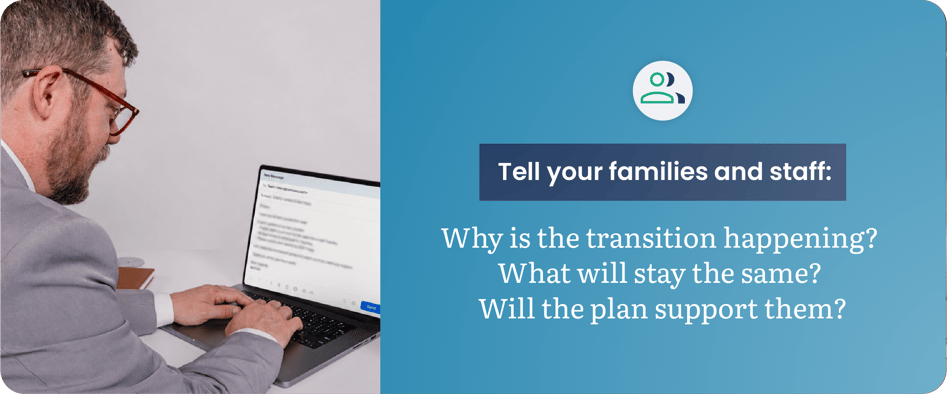
Your staff has helped you build your funeral home. They deserve answers to these 3 questions from you directly:


Timing matters here. Share your plans early enough, so your team doesn't hear about them from someone else first. But be thoughtful about when and how.
Here's the reality: your most trusted employees are the ones who bring your funeral home's care and culture to life every single day. If they walk away during the transition because they feel uncertain or overlooked, your families will notice.
Keep your best people close, keep them informed, and make sure they know they're valued. Their confidence in the plan is what keeps everything steady for the families you serve.
What should your community hear during a transition?
Just like with your staff, the families you serve need to hear 3 things straight from you:


When you share the news, make it about the families you serve, not about you stepping away. The first thing your community hears will shape how they feel about everything that comes next.

How to communicate your funeral home's transition
You don't have to announce everything at once. A phased approach helps you control the message and build confidence:
- Align internally first. Make sure you, your successor, and any critical decision-makers are on the same page about the plan and timeline.
- Confirm the structure. Finalize the details (roles, structure, and timeline) before you start telling people.
- Inform your staff. Start with your leadership team and most trusted employees. Give them time to process and ask questions before sharing with the full team.
- Prepare community-facing messaging. Craft a clear, confident message for families. Keep it simple and focused on continuity.
- Introduce the successor publicly. Whether through an open house, a letter to families, or a community announcement, make sure the introduction feels confident and intentional.
- Reinforce continuity over time. One announcement isn't enough. Continue reinforcing the message through consistent service, visible leadership, and follow-up communication.
How do you preserve what makes your funeral home trusted?
Your funeral home’s reputation was built through decades of consistent care, quiet generosity, and community presence. When leadership changes, those things need to be remembered.
But more importantly, they need to be documented.
Create a Legacy Playbook for your funeral home
Think of this as a simple internal document that captures everything that makes your funeral home yours. It should include:
- Values: What does your funeral home stand for?
- Service expectations: How do we treat every family, every time?
- Leadership principles: What kind of leader does this funeral home need?
- Relationship notes: Who are the key community partners, clergy, hospice contacts, and families you serve regularly?
- Cultural non-negotiables: What should never change about the way you operate?
A Legacy Playbook translates your years of experience into something transferable and actionable. It gives your successor a roadmap for what success looks like and is one of the most valuable things you can pass on.
What should you do first?
Not every funeral home owner is starting from the same place. Where you begin depends on what's weighing on you most right now.
- If your biggest concern is value: Get your financials in order and sit down with your accountant or a valuation professional. You can't plan around a number you don't know.
- If your biggest concern is a family transition: Start by getting clear on your priorities and having an honest conversation about who is interested and ready to take over. Remember, wanting the business and being ready to lead it are two different things.
- If your biggest concern is having no obvious successor: Rank what matters most to you and explore internal and external paths without pressure. Not having an answer today doesn't mean one isn't out there.
- If your biggest concern is unexpected events occurring: Put a continuity plan in place before anything else. Everything else can wait. This one can't.
- If your biggest concern is financing: Talk with a trustworthy lender who knows the funeral profession early to understand which deal structures are realistic for your situation. A conversation costs nothing, but waiting too long can cost you options.

Your 90-day action plan
You don't have to map out your entire transition today. But in the next 90 days, you can make real progress. And that momentum matters more than you think.
First 30 days:
- Write down your long-term vision for your funeral home. What do you want the future to look like?
- Pull together your most recent financial records so they're in one place.
- Ask yourself: What is the single biggest question holding me back?
Days 31–60:
- Sit down with one trusted advisor, preferably a lender who knows the funeral profession.
- Think honestly about your most realistic successor paths.
- Create or update your emergency continuity plan. Don't skip this one!
Days 61–90:
- Line up your next planning conversations based on what you've learned so far.
- Decide whether a formal valuation or financing exploration should come next.
- Start documenting your values, systems, and relationships in a Legacy Playbook.
If you only do one thing this month…
Set aside time to write down your long-term vision for your funeral home and identify who should be part of your first planning conversation. That's it. One step forward is all it takes to stop letting the Villain of Urgency win.
You've already done the hardest part by thinking about what comes next.
Now let's bring it all together.

Your funeral home's next chapter starts with a single conversation
At the beginning of this guide, we named the hidden villains that every funeral home owner must face: the Villain of Urgency. And we said that if you don't choose your funeral home's successor, they will choose one for you.
Now you know what it takes to make sure that doesn't happen:
- You know what succession planning is and is not.
- You know how to define what matters most to you before emotions or pressure cloud the decision.
- You know who should be on your succession planning team and who to call first.
- You understand what your funeral home is worth, what drives that value, and how to strengthen it.
- You've thought honestly about who should lead next and how to evaluate their readiness.
- You understand how transitions are financed and structured so the deal works.
- And you know how to protect the legacy, culture, and care that families depend on through intentional communication and a documented set of values that outlasts any one owner.
Succession planning is personal. It touches family, identity, pride, and purpose. It can feel heavy, and it should — because what you've built matters.
But the weight of the unknown is always heavier than the work of planning.
And the funeral home owners who start early, build a team, and move with purpose are the ones who walk away knowing their legacy is secure.
This guide is a starting point, not a full playbook.
Every funeral home's situation is different, and there are important details (state-specific preneed transfer rules, tax structuring, licensing timelines, deal negotiation, regulatory requirements, and more) that depend on your unique circumstances. Those are the kinds of conversations best had with a professional who knows the funeral profession inside and out.
Ready to take the next step?
A single conversation with someone who understands the funeral profession can save you years of uncertainty. That's what our Lending team at Funeral Directors Life is here for.
With decades of experience working exclusively with funeral homes, we'll help you go beyond a one-size-fits-all approach and build a plan tailored to your specific goals.
It’s been so helpful to work with someone who’s familiar with the profession. The process was so simple. There were no hurdles to jump through. FDL saw our vision, understood our goals, and quickly made the financing work. We’ve had a really great experience.
— Mike McDowell, Chief Operating Officer, Companion Funeral & Cremation Service
Schedule a meeting with our Lending experts below!
Not quite ready for that conversation?
There’s no pressure to make a decision today. If you'd like to learn more about how we work with funeral home owners, we’re here to help.
Click the button below to fill out our form, and a member of our team will reach out to answer your questions.
Meet with us